
Yesterday was our first day of playing the tourist in Alice Springs.

We started out by visiting the National Road Transport Hall of Fame and Old Ghan Museum. Where does one begin. It is huge.

The first section is about the Ghan Railway. After the Overland Telegraph Line was opened in 1872 the area started to become more populated. Being pretty much in the middle of Australia, 1500kms from Adelaide and 1500kms from Darwin, transport was a bit of an issue, with camels being the main form of transporting goods. In 1929 the railway finally reached Alice Springs from Adelaide. The construction was extremely difficult, being hot, dry and remote. Then a flood would come along and wash away some of the work carried out, which must have been very disheartening.

There were a variety of locomotives used over the years with one example on display.
The line only went as far as Alice Springs for many years and in World War 2 it was a major railhead for the military. From here materials and equipment had to be taken to Darwin by a convoy of trucks. It wasn’t until 2004 that the Ghan was extended through to Darwin, as originally intended.
The next section of the museum was the Road Transport Hall of Fame. It was really interesting reading of fellows that were driving early trucks in the outback area from the 1930s and how over the years they were able to purchase ex military trucks and started to tow more trailers, thus creating the first road trains.
Ex US Army Diamond T trucks seem to have been very strong, as one fellow towed 7 trailers. The story goes that there were no brakes on the trailers and he would drive in low gear going downhill, but at the bottom would have to go flat out so that the trailers didn’t all bunch up and break their couplings. Obviously, there were no regulations back then.

There was a photo of another Diamond T with several trailers loaded with drums of fuel. It would have been quite a sight coming down the road.
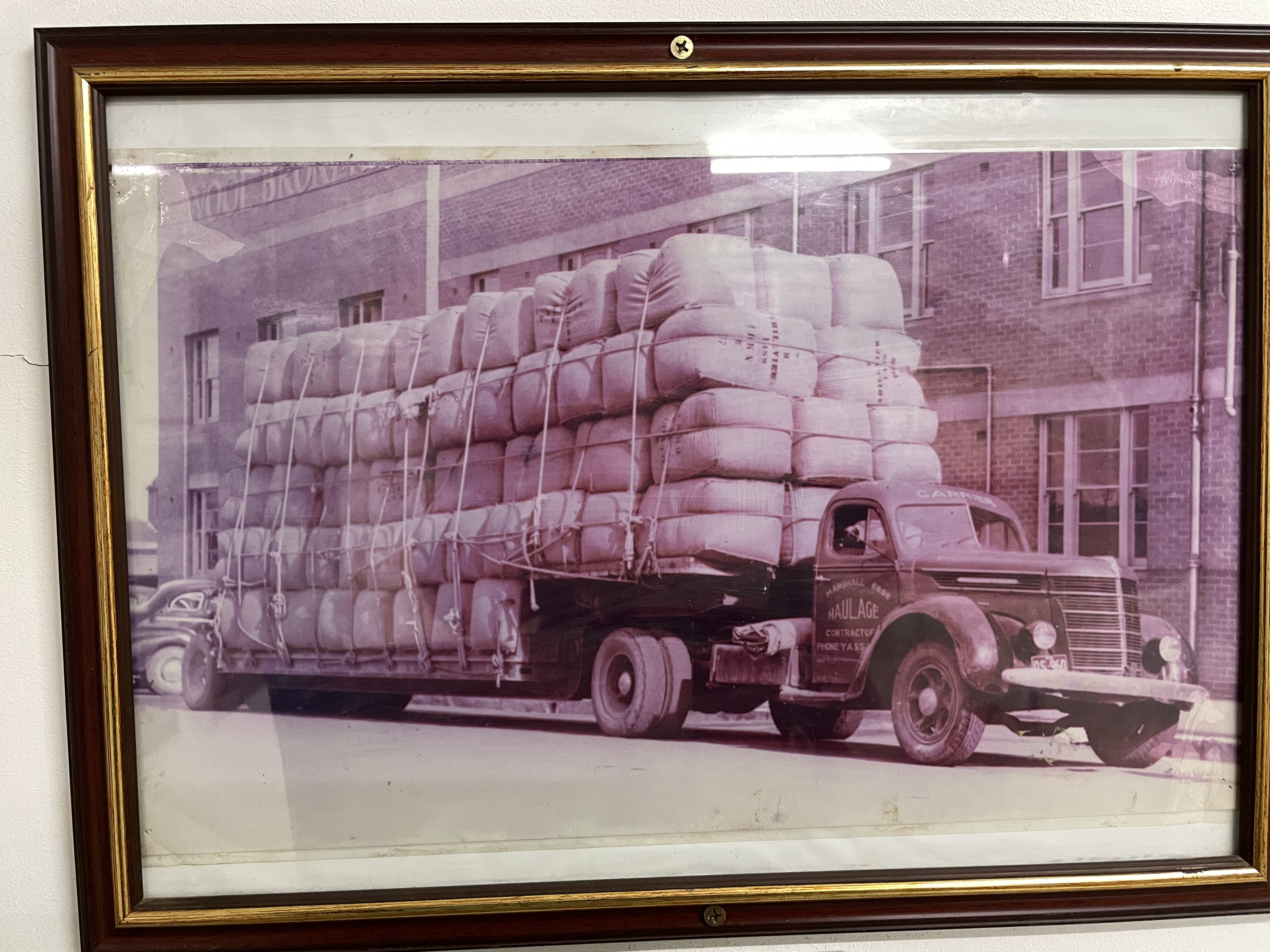
I was also impressed with this photo of a truck loaded with bales of wool.

Next was a huge shed full of cars, trucks and related bits and bobs. Most I glossed over. However, this old Chev caught my eye, as it is the same model as my grandfather had back in the day.

The next shed was rather glitzy. It is the Kenworth Dealer Hall of Fame. I know absolutely nothing about trucks, but found this so interesting. There were fairly new trucks and ones dating back to the early 1970s. For example, the gold one to the left is a 2014 model. The total weight of the truck and payload can be up to 130,000kgs.

The yellow one to its right dates for 1976, is the first fully Australia designed model and the total weight of the truck and payload can be up to 77,100kgs. It would still look pretty flash to me if it was coming along the road.


I like the way they displayed this road train. It dates from 2004, has travelled over 2 million kms and the total weight of truck and payload can be put to 106,000kgs.


This white one was the big daddy of them all. Look at how high it is compared to the others. It is a 2019 model and the total weight for this one is 160,000kgs. It has been used extensively in the mining industry pulling 5 trailer road trains.

Outside there was a small display of Mack trucks. This model was released in the early 1950s and by the 1960s had revolutionised the transport industry in outback Australia, as they handled the conditions so much better than the English trucks.
Anyway, enough of trucks. There were many more interesting things to see, but too much to share here. By now it was time to enjoy lunch in the little cafe before moving onto the next things to explore in town.
Our next destination was back in the centre of town. I have long wanted to buy some fabric with aboriginal designs, however, I didn’t just want to buy them at any old patchwork shop, but either at Alice Springs or Darwin. This has therefore been my first opportunity. I know I could buy them elsewhere, including at Spotlight, but it wouldn’t be the same.
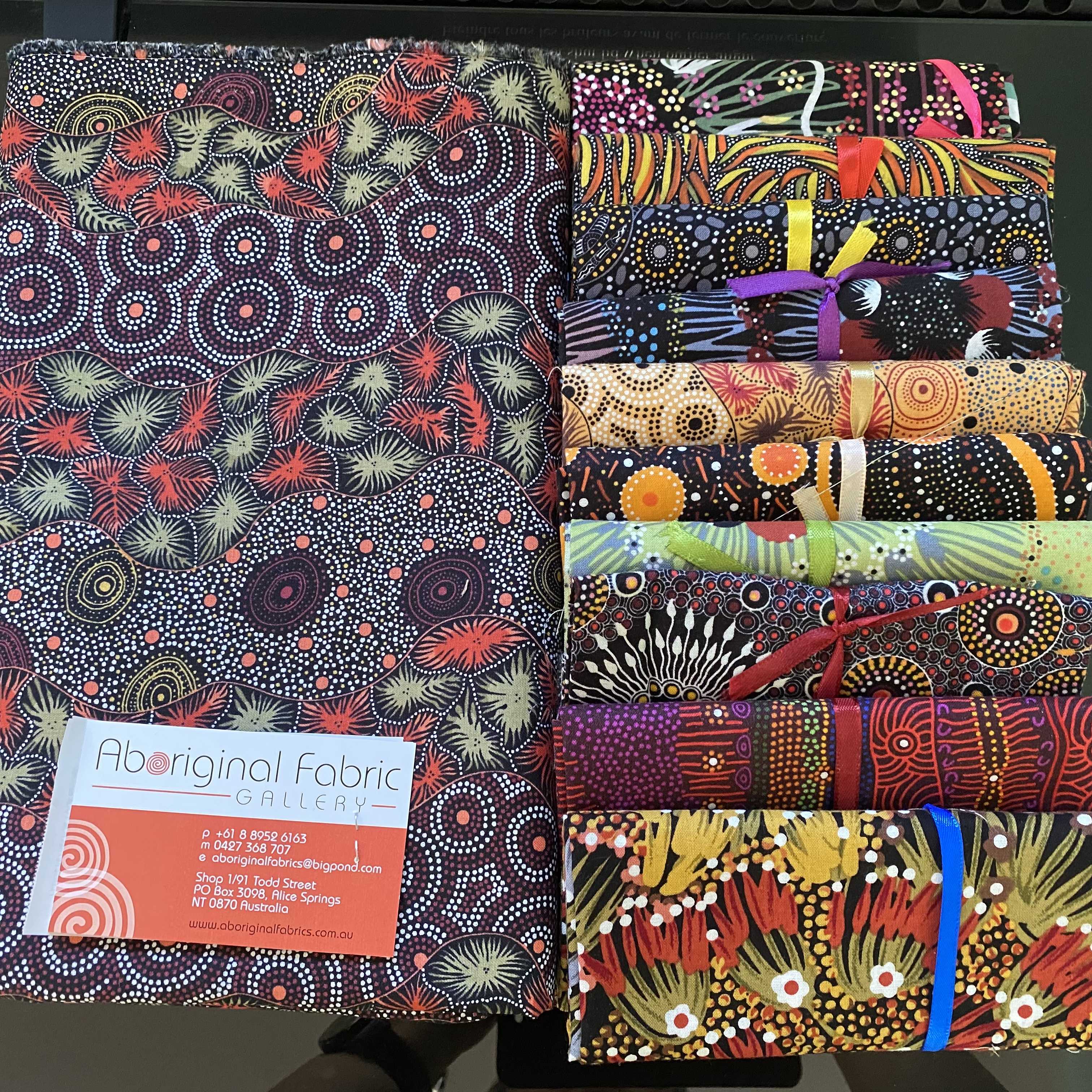
We had heard of the Aboriginal Fabric Gallery, so off we went to find it. What a lovely shop. I forgot to take a photo of the interior, but I may go back again later. We’ll see. So where do you start to work out what to buy? At home we have a vintage standard lamp in our lounge room and we bought a rather striking shade for it a couple of years ago. We were told the fabric was an aboriginal fabric from Alice Springs called “Bush Banana”. Well, that was a good starting point. They don’t sell layer cakes or charm packs. There were some jelly rolls, but they had some fabrics I didn’t like. In the end I chose several fat quarters, including “Bush Banana” (the one at bottom right of the photo) and “Bush Plum” and two metres of another fabric. I will make a quilt for the back of our lounge. Don’t ask me what sort of design, as I have no idea at this stage.
The Women’s Museum was high on our list of places to visit and we arrived at 2.30pm, only to find they close at 3.00pm, so will return another day.

Therefore we headed over to the Araluen Cultural Centre. This houses a theatre, art gallery, two museums, craft cottage and research facility. This stained glass window was in the foyer.

Each year there is an exhibition called “The Desert Mob”, with this year being the 30th.


We enjoyed it very much. Quite a variety of works from the 30 years.
After the gallery we went to the the Museum of Central Australia.

The first section we looked at was a photographic display.

Otto Tschirn was born in the dry north of South Australia in 1890 and after finishing school worked as a blacksmith and saddler and occasionally with a local photographer. In 1915 he and a mate travelled to work at the remote Lutheran Mission at Hermannsburg. In 1916 he returned south the join the army for WW1, but instead married Mary, a teacher, and they returned to Hermannsburg. They had a child in 1917, who sadly died at only a few months of age and they returned south in late 1918. He took some remarkable photos in their time at Hermannsburg, not just stiff posed portraits, but photos of everyday things, even doing the butchering of meat and camp sites while mustering.


Look at the length of the camel train. There were also a few photos of the camels being loaded and unloaded.

Apparently donkeys were used extensively for pulling loads, which is why there is a large wild donkey population in outback central Australia today.
It is rather remarkable that such a wonderful photographic record of that time exists.
The next section of the museum was mainly about the geology and meteors, which doesn’t mean a great deal to me, so I glossed over, as I did with the prehistoric animals. There is just too much to take in at one time.
The third section dealt with the flora and fauna from the area.

One section had skeletons of lots of different animals and birds.

I hate snakes, but was fascinated with the skeleton of a king brown snake.

Another display showed lots of the small kangaroos and possums that live in the desert. These are the very vulnerable species.

Check out these tiny creatures. The Dunnarts look like mice with Mr Spok ears. The Lesser Hairy-footed Dunnart looks like a tiny mouse with a deformed back end. It’s amazing they have ever even been spotted. By they way, they aren’t a mouse, they are actually a marsupial. How tiny must their pouches be. I just did a little Google and they are found in various areas across Australia. The population on Kangaroo Island is now critically endangered after the fires of 2019-2020.

We saw a western bowerbird while having lunch at the Transport Museum. Mick noticed the pink spot on the back of the neck and thought it must be a spot of paint. Evidently not. Rather an unusual marking.
After the museum, we had just a couple of more things to do before calling it a day. Firstly, top up with fuel. After the high prices of the previous week or so, we were surprised that premium diesel was only 237.9/litre at one service station. A very welcome change.


The second was to drive up to Anzac Hill to see the view.

The memorial was placed in 1934 in memory of the WW1 soldiers, but had since expanded to reflect every theatre of war Australia has been involved in.

Once we returned to the van Mick got out his new socket set and replaced the computer module in our fridge, hopefully rectifying the problem of it not working on 12V. As soon as he pulled out the old module it was obvious where the problem lay, as there was a burnt section marked 12V. He installed the new module and it seems to work, Hooray! We don’t know why it stopped working and hope it was just a fault in the module, not something else. How fortunate that we had a spare module, not a spare you would normally carry, but one we have had since the van was new, as our fridge wouldn’t work on 12v then. A new module was sent to us, and then it was discovered that the auto electrician hadn’t wired things correctly. We offered to return the module, but were told to keep it. We may still look at getting another spare, just in case……
And that was the end of a rather full day. There is definitely loads to see here and we won’t get to see it all.
The highlight of the day for Mick was seeing original Albert Namatjira paintings at the art gallery, and for me it was finding some aboriginal fabrics.


