Friday, 4 March 2016

Tassie Day 12

Today was our day off the bike.


 The day started with a pancake breakfast.  We really rough it while camping.

When we finally got ourselves organised(ish), we walked over to the National Automotive Museum.


There is a really good display of cars and motorcycles.  They are all privately owned and on loan to the museum.


They range from veterans, like this 1909 Renault to much more modern.


The 1937 SS 100 Jaguar was rather tasty.


I didn't mind the 1960 Elfin Streamliner either.


There were two 1969 Shelby Mustangs.

Upstairs there were the motorcycles.


They ranged from the little Honda Z50.


To a veteran Ward JAP.


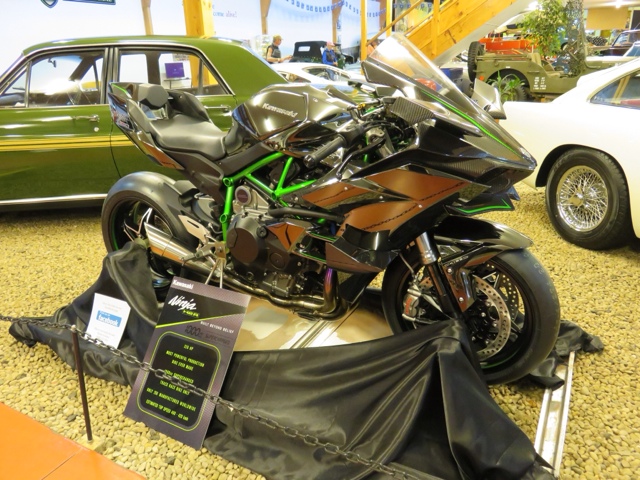
To a supercharged Kawasaki.


Mick's favourites were the lightweight European bikes, in particular the green and gold one in the middle, which is good for 125 miles per hour. Scary!

The feature display was on Peter Brock.  


His original two cars were on display, which was special.


Of course an 05 car was also featured.

Once outside again we crossed the road to City Park to see the monkeys.  A troop of Japanese Macaque monkeys have been in the park for many years.


Some of the males started to have a scrap while we were there.


This fellow looked to be the big daddy of them all.


All the babies ran to their mothers for comfort.


The park was lovely, with a Conservatory with dahlias out the front.


Anyone would think I like dahlias.


Inside was lush and leafy.  Apparently the display is changed regularly.


I think we found our littlest lighthouse while wandering through the park, beside the lake.


As we wandered further through the park we came across an old cottage advertising that they are the community radio station.  For a gold coin donation you could visit the station and their vintage radio collection.  


Of course we went in.


We were taken into the radio studio as well.  They have 45 volunteers, with about a dozen on the roster each day to broadcast.


Very interesting and our guide was entertaining.  A little gem hidden away.


By now it was lunch time, so we found a friendly cafe.  As I said before, we rough it.


After lunch we just roamed around looking at the sites.  I loved the old Gasworks building, which now houses a Hogs Breath Cafe.  Quite a change from its original role.  I presume they cook with gas.


We had planned to visit a few more interesting places, but were running out of time, as we had to be ready for a 3pm tour.


We've never done a brewery tour before, so we decided to visit Boags.  The brewery is bang smack in the middle of town, where it has been since its inception in 1881.


Above is the original building.

No photos were allowed in the actual brewery, which is fully operational as we walk through.  It is really interesting learning about all the processes in making beer.  In the packing hall, bottles feed through the machine at 90 per second.  They were just a blur in some parts.

We also learnt that they have brewed beer for other companies as well.  However, beer consumption in Australia is at a fourteen year low, so 39 staff will lose their jobs very soon.  They will then go back to only brewing Boags brand beer.

After the tour we did the most important tasting.  


Firstly, we tried Boags Premium, which is very light and fresh tasting.  It is only available in bottles, not on tap, and is exported all around the world.  Next we had Boags Red, which is an easy drinking lager, but only available in Tasmania.  Finally, we tried Wizard Smith, which is an English style ale, using hops imported from Kent.  It is alo only available in Tasmania.  This was Mick's favourite.

It has an interesting story behind it.  The beer is only a fairly new release.  Back in the 1920s Len Smith was a cart driver for Boags.  He was a slow plodding sort of bloke. At the time there was a race driver named Wizard Smith, so his mates gave him the tongue in cheek nick name.

In the terrible 1929 floods, Wizard left his flooded home, swam the swollen river and saved his draught horses.  In appreciation, James Boag pronounced that Wizard was never to be sacked from his job.  During the Great Depression that was a valuable thing.  He continues to work there for another 30 years. The naming of a beer is a fitting tribute to Wizard.


A six-pack may be coming home with us for winter.


Out of interst, at the back of the premises there are some hop plants growing.  They are just about ready for harvest.


I've never seen them before.


There was also a nicely painted up one Chevy truck, like the one my grandparents had.


By now we were ready to head back to our camp.  We will have to try and see some more tomorrow.  On the way we saw lots of kids starting their rowing training.

Another social night has taken place, which is very hard to take.


Thursday, 3 March 2016

Tassie Day 11

Wednesday was forecast to be the best day this week weather wise, so we went to visit Woolmers Estate and the neighbouring Brickenden Farm Village.  We were joined by our friends from Oberon.


It was like riding down an English lane on our way.

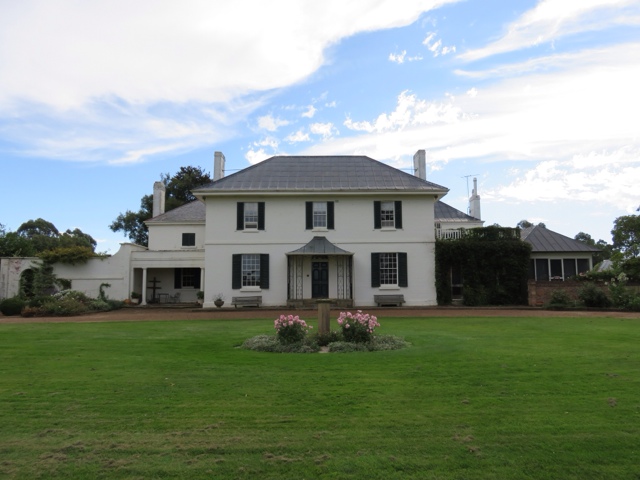
Woolmers was given as a land grant of 800 acres to Thomas Archer, an early free settler in 1813.  He selected excellent farming land bounded by two permanent rivers.  With his assigned convicts he did very well.  His father and three elder brothers subsequently also immigrated to the area and commenced farming.


We took the guided tour through the house.  It is a low weatherboard structure.  Thomas was very involved in civic life and politics, so he felt he needed to make his house a little more suitable to his standing in life and added a couple of extra rooms for entertaining.


They are very grand.  Furniture from the finest furniture houses in the latest style of he 1850s.  No photos were allowed inside.


Thomas' son Thomas was to take over the estate, but unfortunately died of scarlet fever at a young age, so the property was then left to his 10 year old son, Thomas the 3rd, who was sent to England to be educated.  The propery, now 35,000 acres, was leased.  When he returned, he had no interest in farming and continued to lease the land and just visited when he wished.  This continued for and few generations.


Eventually, as the land was not being farmed productively by the family, the government resumed most of it, firstly in the early 1900s and then for soldier settlement after WWII.


In the 1930s Thomas the 5th and his wife Marjorie came to live at the property.  Marjorie updated the fabrics on the furniture and had the walls papered.  This is how the property looks now.  They only had one son, who was sickly as a child and Marjorie was advised that contact with other children could lead to an infection that could be fatal for "Young Tommy".  Therefore, she kept him home in isolation.  He was an only child and became virtually a recluse in adult life as he had always lived that way.


As a result, the property had become a time capsule.  Young Tommy created a family trust on his death and the property is now on the World Heritage Register, along with Brickenden, as a site of significance for convict assignment, as the majority of convicts were assigned to properties.


In 2001 the National Rose Garden was established on the site of the old orchard.  It would be beautiful in spring time, but was not putting on much of a show when we visited.  I did like "Elle".


By now it was lunch time.  After lunch we visited Brickenden.

When Thomas' eldest brother William Archer arrived he took up the adjoining land on the other side of the Macquarie River and named it Brickenden.

William, like Thomas was the son of a miller, so had to learn farming practices.  


Unlike his brother over the river, he concentrated on farming rather than civic life.  His original weatherboard cottage from the 1820s is still standing.  


The interior construction was intriguing, with brick infill between the frame timbers.


Like Woolmers, Brickenden was founded with convict labour.  Most of the original buildings still standing.  This one is a granary, with its unusual vermin proof footings.


The tiny chapel is a feature.


The rustic cookhouse was interesting.


Very basic inside.


The poultry house was more substantial.


It is still used as a poultry house.


The Blacksmiths.


Brickenden continues to be a family farm with three generations living in the family home.  


The most recent Mrs Archer instigated opening up the early buildings which were no longer being used, and falling into disrepair, to the public.  


Cottages are available for accommodation and the barn is a popular wedding venue.


Picture the cavernous barn decorated for a wedding.  It would be spectacular.

By the entrance gate there was a huge pot that we felt would be good for cooking missionaries, as per the cartoons, but we had to make do with Mick.


Once we had finished visiting the farm village, we crossed the road to where the current home is located and were  able to visit the heritage gardens.


Poppy the dog, with her tennis ball kept us company.


The coach house was rather tasty.  Bikes and machinery made you realise that this is still a working property.


Before we started out tour of Brickenden we watched a DVD on the family that had aired on the ABC.  It was saying how it had stayed in the family and at the end discussed wether the youngest generation would keep the farm going or would do something else.  William was 16 at the time.  Apparently, that DVD is ten years old and he has now completed Ag College and has returned to the property to work alongside his father Richard.


The garden has mainly been Richard's mother's pride and joy. Richard's parents are about to move from the family home and retire in town.  


It appears that the Archers at Brickenden will continue, unlike at Woolmers.

We are very fortunate that both these properties are so well preserved.

As we were about to leave Richard Archer came over for a chat.  He was a nice, ordinary farmer.  He does most of the work maintaining all the buildings.  He said he is pleased to see the buildings preserved, as they were falling down when he was a kid.

We intended to just have a quiet evening back at our camp site, but it ended up very social, being joined by our for friends and another couple that both we and our friends had run into during our trip.