Showing posts with label Waggas. Show all posts

Saturday, 25 May 2024

Canberra - a Century of Quilts

The main reason for our timing to visit Canberra was to see the quilt exhibition at the National Gallery, and in particular, the Rajah Quilt. The exhibition wasn’t all that large, but there were some lovely and varied quilts.

We start with a possum skin cloak, such as the aboriginals made.  This dates from the 2005, so a contemporary interpretation.

Early European settlers also made use of the warm possum skins.  This one from Tasmania has the pelts backed by a woollen fabric.  It is somewhat unusual with the tails still attached.

This quilt was made during the 1870s and 1880s, by a lady who was a dressmaker.  She entered it in the local show each year for 10 years, winning first prize every time.  You have to laugh.  It is edged with a braid and backed with a fabric commemorating Queen Victoria’s 1887 Golden Jubilee.

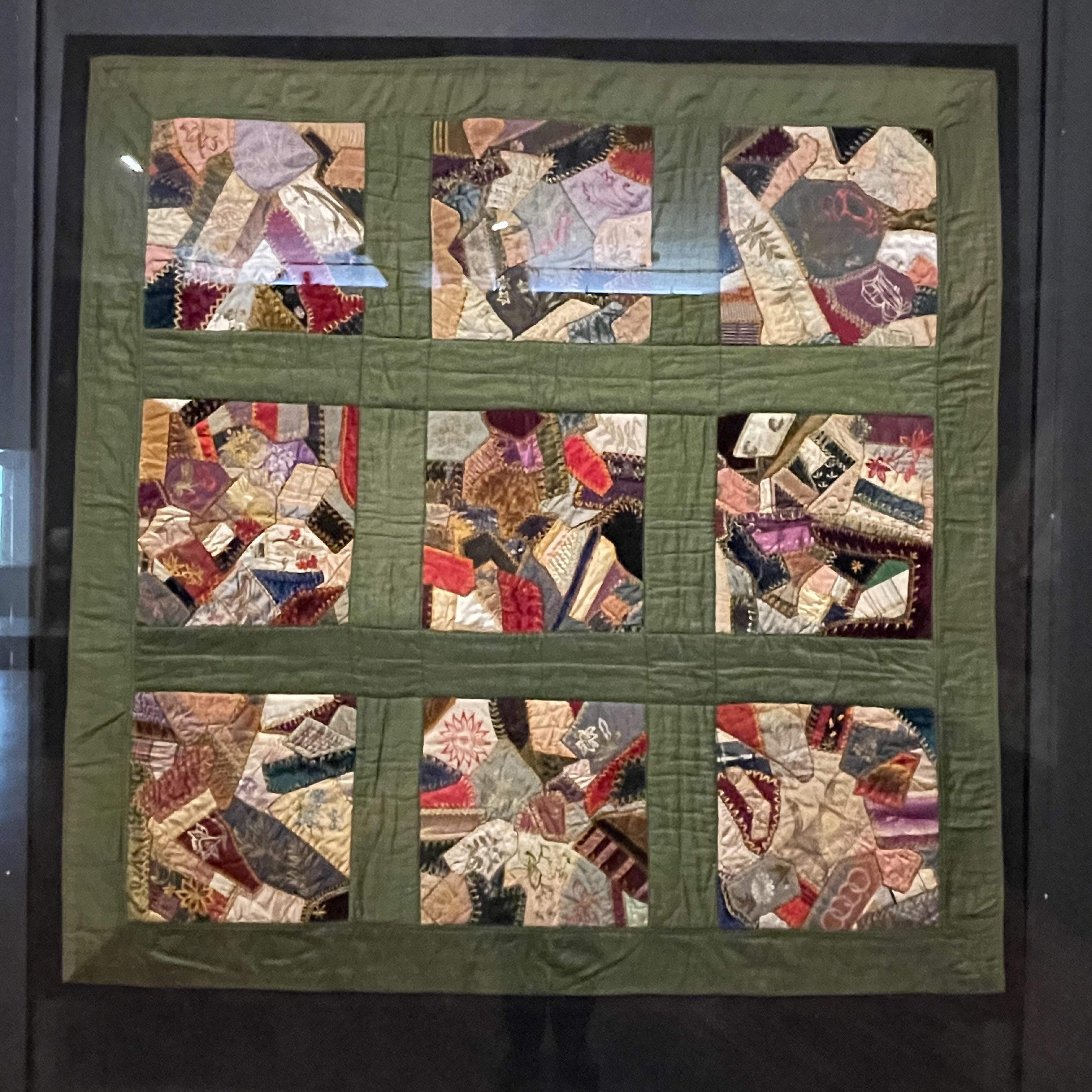
There were two crazy patchwork quilts, quite different in style.

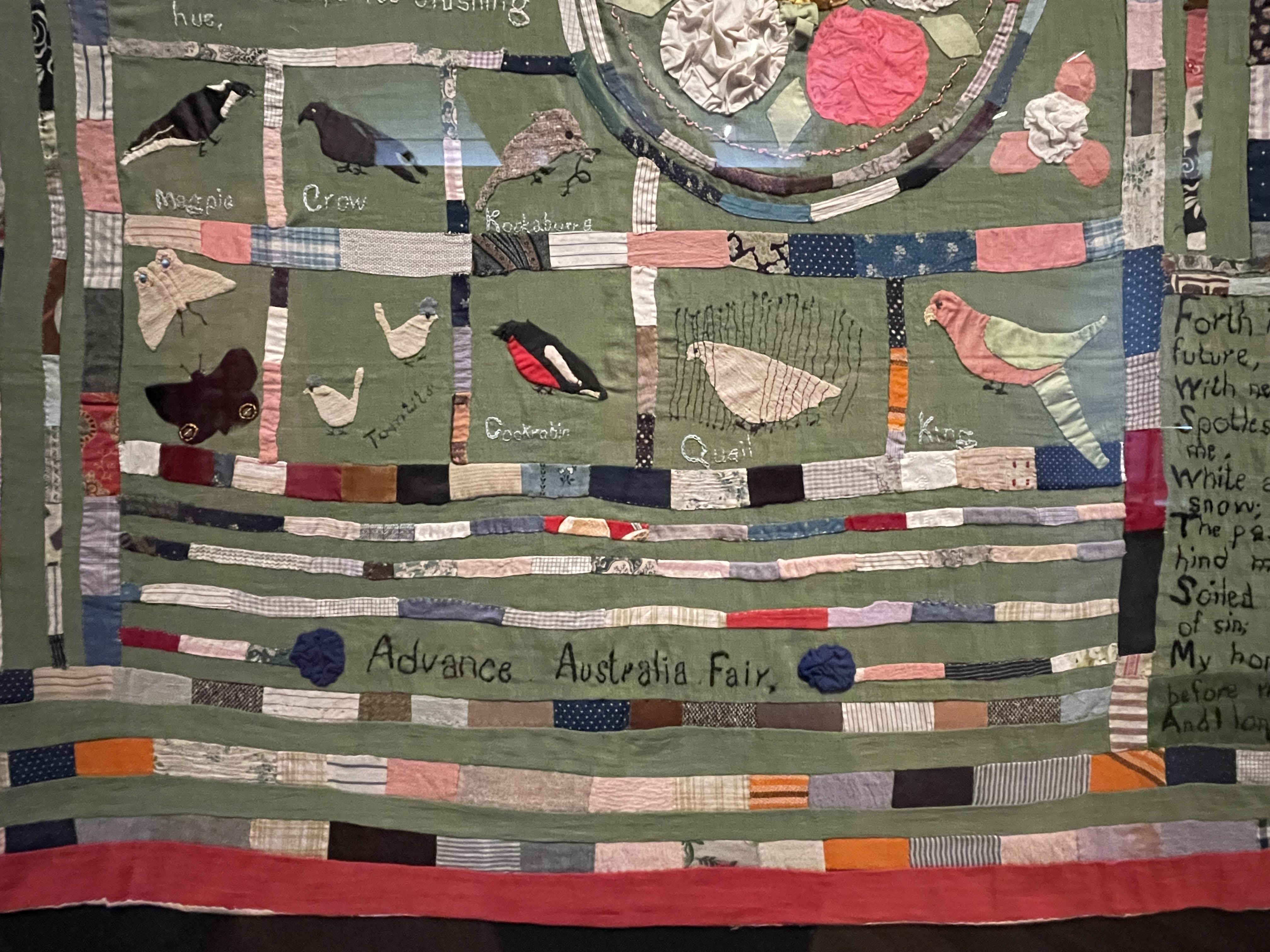
This next quilt was interesting. Quite naive in style, it was made when the lady was in her 80s and she apparently made at least ten for her grandchildren.  It is unusual, as it features aboriginals in the design.

The log cabin caught my eye. Made between 1910 and 1928, the logs are only about a quarter of an inch wide.  The fabrics were all scraps from a drapery store.

This was an example of a Wagga quilt, made from scraps of woollen fabrics with a cotton backing.

There was a second, more utilitarian, Wagga quilt made from tailoring samples.

From a distance, this quilt is rather bland, but when you look closer, there are some gorgeous 1930s fabrics.  The sashings appear to be a rather fine machine embroidered fabric that would be more likely to be seen on an evening gown.  The maker had rheumatoid arthritis, and had one of the very early electric sewing machines, which made this type of work possible for her.

The next one was rather unusual, as it was made from agricultural show prize winning ribbons for their cattle. She had even made a bag from more ribbons to store it.  It has a lovely subtle colour wash to it.

There was a lovely hexy quilt, which uses fabrics similar to the Rajah quilt, so is dated from 1840 - 1860. Some are fussy cut, while others are random.  There seems to be a bit of a layout pattern, but not really consistent.  It has a gorgeous backing fabric.

There was a beautiful unfinished diamond quilt.  In 1899 the maker died at the age of 30 without completing it.

This beauty is a table cover made from silks, satins and other luxury fabrics.  The design and colour placement is stunning.

There was one other beautiful red and white quilt, but there was a large group of women in front of it and I forgot to go back, which is a pity.

And finally, the Rajah Quilt - just to prove that I saw it.

It was much larger than I expected. There is some rather detailed stitchery, suggesting that at least some of the women were proficient needle women.  There is quite a bit of broderie perse in the applique.  Apparently there was just one free woman on the voyage and at the age of 23, she was sent to coordinate the quilt.  What a task that must have been.  

The quilt was gifted to the Governor of Tasmania’s wife upon their arrival.  Somewhere along the line it was sent back to England.  It is unknown if Elizabeth Fry saw it or not.  Then it disappeared, only to be discovered in an attic in Scotland in the 1980s.  Having been stored away and not used has contributed to the fact it is is such wonderful condition for its age.

Anyway, I’ll let the photos do the talking.

I’m so pleased that we made the trip down to see the quilts, as it is rather rare that the Rajah quilt is brought out, due to its fragility.

If you are interested, there will be a one hour long live stream event by the curator and conservator, held on 29 May at 6.30pm eastern Australia time that will discuss the Rajah Quilt in depth.  Here is the link to register.


Saturday, 23 February 2019

War and Pieced Quilt Exhibition in Cowra

In the local paper a couple of weeks ago there was an ad for an exhibition at the Cowra Art Gallery.  Cowra is a small country town just over an hour west of us.  It was rather unusual to have such an ad in our paper and the content of the exhibition was also rather surprising.


What a coup for Cowra.  The ad also mentioned that Dr Annette Gero would be giving a talk about the exhibition this afternoon.  We had nothing planned for today, so guess where we went?

Cowra is one of those towns that every time you drive through on your way to somewhere else you say "We must have a good look here some time". Too far to just pop up the road, but too close to go and stay for the weekend.  This was the perfect opportunity.


We had a lovely morning tea, sitting under an enormous, shady grape vine.


How magical is that!

There are two fabric shops in town, which I guess is sustainable, as there is no Spotlight within an hour's drive.


Mick sat in the "Patient Husband Seat", but I'm not too sure how patient he was.

We then found an interesting antique shop as well.


I did make a couple of purchases - some more 1930s reproduction fabrics for Splendid Sampler 2 and a rather nice vintage sewing machine accessories box, with a few accessories inside.  I just thought it was cute in the red.

So, after all that, we went to the art gallery.  The exhibition was wonderful.  No photographs are to be shared on line, so I'll just tell you a little about them.

Annette came across her first military quilt when she was searching for old Australian quilts, back in the early 1980s.  She has been an active collector ever since.  There are less than 200 documented world wide and Annette owns the oldest private collection.  This collection has just returned from an exhibition at the International Quilt Study Centre and Museum in New York.  It was voted one of the best 10 exhibitions in the USA that year.  I still can't believe that it is on display in Cowra.

The display consists of quilts mainly made out of fabrics used in military uniforms.  The fabric is a very finely woven wool that was felted at the time of manufacture and therefore doesn't fray.  There is no modern equivalent.  The method is "intarsia", which means the fabrics are just butted up together and whip stitched.  There is no turned over seam allowance like the usual quilt.  Some date back to the Napoleonic Wars in the early 1800s and one even to 1766.  Most seem to have been completed by men from the Prussian area in Germany.  There were also a few more modern ones.  There was even a wagga made from old army blankets.

Some had beading.  These mainly seemed to come from India.  A couple had tiny circles of fabric, about a quarter of an inch in diameter, stitched on with a bead or just a stitch.  The circles were cut out of button holes.  A few had the finest button hole applique that I have ever seen.  The details were incredible.  They think that many would have been made by regimental tailors, as they would have the skill and access to fabrics.  There is a popular belief that they were made by convalescing soldiers as occupational therapy, but the historians now don't believe this to be true, as the workmanship is too good for someone injured and the designs are all unique. 

The colours were so rich - reds, yellows, blacks, whites.  One, which they think came from the Czechoslovakia area, even had pinks and purples.  Surprisingly, most were in excellent condition.  A couple were a little moth eaten, but that is all.  The colours don't appear to have faded at all.

After we visited the exhibition we attended the talk.  Annette was very engaging as she chatted about the history, techniques and the research that has taken place.  This was followed by a beautiful afternoon tea.

You can see some of the USA exhibition herehere and here.  Not all those quilts were on display in Cowra, and some ones that Annette has only recently acquired were in the Cowra exhibition.

I am so glad that we chanced across the ad in the paper.  If anyone is in the area, the exhibition is open until 28 April 2019.  It is definitely worth visiting.

Wednesday, 15 August 2018

A New Adventure - Home to Cardiff


It was a cold and frosty morning when we left home on Friday to drive to Sydney.


We flew out mid afternoon with Singapore Airlines.


Of course we had to take our usual selfie at the start of the flight.


There was a brief stopover at Singapore before we arrived in Heathrow at 5.30am, after our 23 hour flight.


Next we hopped on a train to the lovely Paddington Station.


Where we hopped on another train to Cardiff in Wales.  Why Cardiff?  Well, we have toured quite a lot of the UK but have not really touched on Wales before.

It was a glorious blue summers day when we left London, but as we travelled west the cloud cover increased. By the time we reached Cardiff it was full cloud cover.

Our hotel was perfectly located, being close to the train station and also right in the centre of the city.

By late morning we were ready to start exploring, just as it started to drizzle.  It proceeded to rain for the rest of the afternoon.  We had to chuckle, as they have had hot dry weather for the last month.


The main street looked nice and cheery with the floral displays.


We discovered some lovely little arcades.


And stumbled upon the Cardiff Markets.


Where we bought a punnet of delicious big British cherries.


Some Welsh Cakes may have been purchased from this stall.

There were all types of stalls.  One just sold umbrellas.  Mick purchased one, as we had forgotten to pack his.  We always say that if we forget something "there are shops".  This came into play.


We found a nice little tea shop in one of the arcades for lunch.


We went for a walk along the River Taff to collect our hire care and were pleased to see that they are painting water towers over here too.


Back in the city, there are modern buildings as well as the old.


We still had plenty of time, so headed off to visit Cardiff Castle.  Everything is so nice and close.


The castle was interesting to wander around. 


No one seemed worried by the wet weather, but I'm sure it would have been much more crowded had the weather been fine.


The old and the new - with the Millenium Stadium in the background.


There was a wedding reception taking place in one section and the bridal car was rather lovely -  a Beauford, which I've never heard of before.


One section of the castle was the home of the owners.  After the bare keep, it was rather sumptuous.


The Arabian Room was extremely lavish.  The ceiling.


The floor.


 The dining room ceiling.


The drawing room was redone in the mid 20th century as the lady of the house found the existing decorations to heavy.


The library was another amazing space.


I was fascinated by the beautiful locks on the drawers in the display cabinets.


I was enchanted by this huge old spreading tree.  It was a Home Oak, a variety I'd never heard of before.


The clock tower was highly decorated as well.


Another interesting building in the city is the Cathedral.


The interior is fairly simply decorated with a barrelled timber ceiling.

By now we were starting to feel a little tired, so headed back to the hotel to take  a nap prior to going out to get some dinner.  However, that never happened and we slept for about 12 hours.

It had been a big day.  We had no real expectations of what we would see in Cardiff and really enjoyed our brief visit.

Now to start our mystery tour of the rest of Wales.